Felixstowe Book Festival

  • Home
  • Contact
  • Blog
  • About
    • About Felixstowe Book Festival
    • Your Visit
    • Festival Team
    • Felixstowe Book Festival Book Club
    • Archive
      • 2025 Festival
      • 2024 Festival
      • 2023 Festival
      • 2022 Festival
      • 2021 Festival
      • 2019 Festival
      • 2018 Festival
      • 2016 Festival
    • Ticket Information
    • Privacy policy
  • Support us
    • Become a Friend
    • Volunteer
  • Gallery
    • Gallery 2025
    • Gallery 2024
    • Gallery 2023
    • Gallery 2022
  • Events
    • Felixstowe Book Festival 2026 – A celebration of Books By The Sea!
  • Sponsors
    • Our Sponsors and Funders
    • How to sponsor

The book that changed me

28 February 2026 By Steph Mack

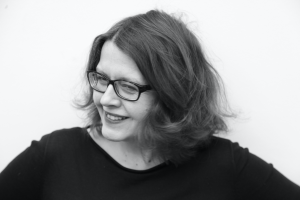
Festival blog editor Louise Millar on Denis Johnson’s Train Dreams, the novella that fixed her writer’s block and returned her to the joy of reading

As the author of four published crime novels, to experience severe writer’s block, suddenly, in the middle of book five, felt like a nightmare.

How did it happen?

Unforeseen, traumatic family events can happen to any of us. In my case, they came all at once, leaving me both hypervigilant and foggy brained.

‘Secondary trauma’, was the diagnosis a doctor gave me, describing it like a mild PTSD.

I brushed the news aside, and returned to work. It would all be fine, I was sure. My urge to write remained strong, and if I kept going, the writer’s block would surely disappear.

But as I battled on through my fifth thriller, the plot became increasingly tangled. I felt as if I were tipping words from a dictionary onto the page and shuffling them around. They made sense, but I couldn’t feel them.

And if I couldn’t feel them, how could a reader?

Worse, I was struggling to read now, too. My eyes were skating off the page. Stephen King says, to be a writer one must ‘read a lot, and write a lot’ – and now I couldn’t do either.

So I put my tangled fifth novel away, and started a new one.

A year later, that wasn’t working either.

Later, a psychologist told me that when our brains experience trauma, they switch to survival mode, and take ‘offline’ the parts we don’t need. My imagination, it seemed, had gone ‘offline’, along with my ability to ‘feel’ words.

Abjectly, I found myself scrolling through Instagram, watching Netflix, and managing the odd audiobook – with lots of rewinds – eyeing the novels on my husband’s bedside table, envious of his ability to disappear into imaginary worlds I could no longer access.

As our family situation thankfully improved, and the fog lifted, I returned to writing short pieces about art and music, but it still felt like running through water. The only fiction I produced, whose words I could feel, was, not surprisingly, a short story about a woman fighting to regain her voice.

Then, in 2025, just before Christmas, I was telling a friend at work, who loves reading, how much I missed it.

‘Have you read Train Dreams, by Denis Johnson.’ He said, ‘It’s short – a novella.’

Truth was, Train Dreams, a story about a man working on the American railroads, sat on my bookshelf at home. I’d given up after Chapter One.

Later that day, as I was talking to another writer friend, I heard him pause mid-sentence.

‘Do you know you’re on that thing constantly?’ he asked.

I looked up and realised I’d been scrolling as he answered my question about how his own book was progressing.

‘And when you do talk,’ he continued, ‘it’s like your brain is scrolling through Instagram. It leaps about from idea to idea.’

I stood stunned. But I couldn’t argue. He was right. Something had to change.

That night, I went home and took Train Dreams off the shelf. It was 103 pages. Surely, I could manage a third of a novel.

My eyes skated off the first page, searching for my phone. I forced them back, and read on through the first chapter, then two more, battling to stay focused.

Before I knew it, I was immersed in beautiful elegiac writing about a character living in a forest scorched by fire, his memories buried in ash, watching new, green life return through the blackened ground, but now in different form.

The next morning, driving home from the gym, I felt an urge to do something. What was it? To check my phone? Then I realised it was to get back to my book.

I read on through Train Dreams that day. In it, I encountered an astonishing image of an injured forest creature that I know I’ll never forget. As I read on, I began to feel a rhythm to the novella that reminded me of train stops, each one a destination in the journey of a train labourer’s life through a rapidly changing America.

Finally, I made it to p103. We talk a lot about powerful opening lines in novels. I’m not sure I’ve read a more powerful last line, than in Denis Johnson’s Train Dreams.

I shut the book. I had done it. I could do it. I was a reader again. And now I wanted more.

Over Christmas I gathered and bought recommendations, including another novella by Hemingway and Barbara Kingsolver’s Demon Copperhead. In the New Year, I read Foreign Affairs by Alison Lurie, and raced through the short chapters of Clare Leslie Hall’s Broken Country. Right now, I’m in the middle of Patti Smith’s The Kids.

Then a strange thing happened two weeks ago. I woke up realising I had dreamt, for the first time in years.

My brain was sending me stories again.

I found myself thinking about Broken Country, and my own fifth novel. Would cutting the tangled plot into short chapters help?

A new character jumped into my mind, as I was driving to work. An ambitious young woman who works in Whitehall, who sees something she shouldn’t on the way to an interview.

I found the last draft of my fifth novel on my laptop, and cut in half the first chapter, about a woman who lives alone in rural Scotland. It suddenly felt more punchy. I inserted a new Chapter Two, set in London, introducing my new character. My brain began to chug along, then speed up, as it went to work connecting the two women and their locations.

If writer’s and reader’s block was just a stop on my own life journey, then I’m hoping that Denis Johnson’s Train Dreams has sent me onwards again.

Louise Millar – Blog Editor
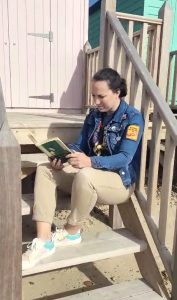
“I was struggling to read now.”
Denis Johnson’s Train Dreams


Filed Under: Book Blog, Felixstowe Book Festival 2026

Felixstowe Book Festival Opening Event!!!!

16 February 2026 By Steph Mack

Our main festival tickets might not yet be on sale until Wednesday 1st April, but you can already secure your tickets today for our Opening Event on: Friday 26th June from 7.30pm
Venue: Two Sisters Arts Centre, High Rd, Trimley St Mary, Felixstowe IP11 0SP


Scenes from a Life features poems from Blake Morrison’s Afterburn as well as his prose writing. Blake’s readings are accompanied by music composed and played by members of the Hosepipe Band

This event is a collaboration between Felixstowe Book Festival and the Two Sisters Arts Centre
Tickets £15 (£13) available to purchase here

Filed Under: Friday Festival Opening Event

Announcing our first Pre Festival Event in May with Nicci French

8 February 2026 By Steph Mack

This year we’ve again teamed up with the rather splendid Orwell Lady River Trips. In May, ahead of the main festival in June,  you have the chance to immerse yourself in the picturesque Suffolk countryside. We are inviting you to journey along the River Orwell, one of England’s most beautiful and historic rivers.

Hop onboard from Ipswich Waterfront, sail gently along the river and hear from the writing partnership of journalists Nicci Gerrard and Sean French AKA Nicci French.

Focusing on their career, writing techniques and their latest book What Happened That Night (published February 2026).

Books will be available to purchase on board. There will be plenty of time to mingle, ask questions and to have your books signed too.

Ticket price includes delicious homemade scones served with fresh clotted cream and lashings of strawberry jam. Drinks can be purchased from the licensed bar on board.

The whole trip is 3 hours, leaving Ipswich at 2pm. Tickets are £44pp, available to purchase here

Places are limited so early booking is advised. This special event in May is one of our Pre Festival Events ahead of the Felixstowe Book Festival which takes place this year from Friday 26th through to Sunday 28th June. A full list of authors joining us this year will be released soon. To be first in the know, sign up to our newsletter and follow us too on social media @FelixstoweBookFest

Filed Under: Orwell Lady, Pre Festival

What does the Felixstowe Book Festival mean to you?

23 January 2026 By Steph Mack

As we start preparations for this year’s 2026 festival, Louise Millar asks three festival regulars how our exciting local event has changed their lives

Stephen Amer sound engineer

‘The Felixstowe Book Festival means a great deal to me, both professionally and personally.

‘My role at the festival is to provide sound for the Palm Room events and, more recently, also the conservatory. Along with a team of two other technicians, we make sure that authors and audiences can hear each other clearly and comfortably.

‘On the surface that might sound straightforward, but the Palm Room, whilst a stunning, historic room in the Grade II listed Harvest House, has glass-domed ceiling, marble floors and not a single scrap of fabric, curtain or carpet! A sound technician’s nightmare. In the run up to the festival and over the course of a busy weekend it involves a lot of preparation, adaptability and calm problem-solving.

‘During the festival I’m responsible for setting up and running microphones, managing levels, and responding quickly to the different needs of each event. Every author is different: some project naturally, others speak more quietly; some love a handheld mic, others forget it’s there altogether.

‘We do our best to try quietly to make things work for most people (of differing hearing abilities) so that conversations can flow and the audience can stay engaged without noticing too much that there is a technical side happening.

‘Being part of the Felixstowe Book Festival feels special because it’s more than just another job. Meg (Reid, director) and the team curate a line-up and create an atmosphere that’s welcoming, well-organised and genuinely appreciative of everyone’s contribution. Over the years, that sense of being part of a trusted team has grown, as has my connection to the festival itself. I’ve enjoyed the professional challenge of working in spaces like Harvest House, but also the community feel of the festival – seeing familiar faces return each year, and watching audiences respond so warmly to such a wide range of speakers.

‘My highlights have included working with some high-profile authors such as Sir Terry Waite, Stephen McGann – who was extremely charismatic and very funny – and Carol Drinkwater. Equally memorable, though perhaps less well known to some, was Dame Stella Rimington, who offered fascinating insights into the intricacies of life as both the head of MI5 and the first woman to hold that role. Robin Ince was a joy to experience as a speaker: funny, compassionate and hugely engaging, while Jenny Boyd shared wonderful and revealing glimpses into the hidden world behind her experiences with some of the world’s biggest rock stars.’

June Stockdale, festival volunteer

‘As soon as I saw the festival was coming to Felixstowe [in 2013] I thought I’d died and gone to heaven. I wanted to be part of it. I didn’t know what was involved but I saw Meg at an author talk in the library, we connected, and becoming a volunteer went from there.

‘The first festival, in the Orwell Hotel, was a little bit chaotic. People didn’t know what to expect. When I turned up the first day, somebody had changed the rota at the last minute, and said they didn’t need me. Then they saw my face! And gave me a job!

‘As volunteers, we do all sorts – take tickets on the door, assist audience members finding rooms, and fetch water for authors. I’ve met some amazing volunteers over the years. Because you share a love of books, you have a common purpose. You say, ‘Have you read that one?’ and start talking.

‘Having the festival here in Felixstowe, has meant so much to me because I’ve been a book lover my whole life. I’m an only child, and when I was young, books were my brothers and sisters.

‘I started with comics. My mum used to do a bit of cleaning, and I’d go with her. On the way home, she’d stop at the newsagent to buy me a comic, and when we got home, she’d make a drink, and she’d read it to me.

‘At school, I progressed to Enid Blyton. I’d go off somewhere in my head. I was part of the Famous Five gang!

‘As an adult, I like to try most kinds of books. I always have five or six on the go. I have them in every room and in my bag on the bus. When I have a bath, I read, but I have to make sure it’s one of my own, in case it goes in!

‘The excitement for me of volunteering at the festival has always been seeing authors in the flesh, often my favourite writers, and hearing them read. It sounds silly but you put them on a pedestal, but most are so lovely and talk to everybody.

‘One of my favourite memories is being on the door of Guy Fraser-Samson’s talk on his book about cricket. When I saw it on rota, I thought, “Oh great”. I knew nothing about cricket, and only six people attended. But my goodness, what an incredible talk it was. The amount of facts and figures – and no notes! He was so eloquent, I was absolutely hooked.

‘I’ve had many happy years volunteering at the festival, but my favourite thing of all is when you get there early, to set up, and they’re opening the boxes of brand new books at the book stall. The smell! I just was to touch them all!’

Barbara Lamberton, attends the festival annually with her husband Alan.

‘The festival is one of the highlights of our year. Beforehand my husband and I examine the brochure and decide which talks to book. He likes non-fiction books whereas I like mostly fiction and, in particular, crime fiction.

‘We normally book between nine to 11 talks. Sometimes we both go to a talk together but usually we are separate.

‘There is always a feeling of anticipation and appreciation of the wonderful venue. We meet old friends and new people, and we immerse ourselves in the magic of the written word. It is so interesting to hear authors speak about their work, and read from their books, and answer our questions.

‘It would be hard to pick our particular highlights, because there are so many. The very first festival was opened by Martin Newell & The Hosepipe Band, and he remains a favourite of ours. We have several of his books of poetry as well as CDs of ‘Black Shuck’ and ‘The Green Children of Woolpit’.

‘I also love Nicci French. I recently read ‘The Last Days of Kira Mullan’, their latest book, in three days, I could not put it down! It is always wonderful to hear Nicola Upson and Mandy Morton – Tea at 3 is such a highlight. Mandy is a superb reader.

‘Ruth Dugdall is another author I met at the festival and I have really enjoyed her books: plus Salley Vickers, JoJo Moyes, Louise Doughty, Mark Billingham, Harriet Tyce, Louis de Bernières… who could choose?

‘Next year I do hope we shall see Martin Newell again, but I am always thrilled to find new authors, fiction and non-fiction, because I read quicker than one author can write! I would love to hear more poetry too.

‘Whatever happens we will continue to support our wonderful book festival.’

Tickets for this year’s festival will go on sale from Wednesday 1st April – to be first in the know when it comes to visiting authors for this year’s Festival go to our website  and sign up for our newsletter

Filed Under: Uncategorized

Happy Christmas from Luxembourg!

19 December 2025 By Steph Mack

Festival author Ruth Dugdall takes us on a special Christmas visit back to the location that inspired her relaunched Cate Austin crime series

I hadn’t been to a Christmas market until I moved to Luxembourg with my husband and two children and we fully embraced the tradition of drinking warm Gluhwein (or hot chocolate for the kids!) and eating gromperekichelcher – a traditional Luxembourg ‘delicacy’, if that’s the right word for fried potato served with a carton of apple sauce. It really is delicious.

Though Luxembourg is a small city it packs a punch with its markets, selling gingerbread hearts iced with messages and glass globes full of snowy scenes. For two years, the month of December was full of family trips to the market, to meet friends and go on the big wheel and eat salt-studded pretzels, and all the time I was working Nowhere Girl which takes Cate Austin, my Suffolk-born probation officer, to Luxembourg.

Ten years after leaving I returned this year, because Nowhere Girl and the rest of the Cate Austin series is being relaunched by Harper Collins, starting in January 2026 with The Woman Before Me. I wanted to re-fresh my view of Luxembourg and notice any changes. They now have a tramline, so I needed to include that! As we walked around the cobbled streets that we once knew so well, something limbic happened and the ten years melted away. Our faces were illuminated by lights as we visited wooden chalets selling trinkets, and looked up at the big wheel wondering if we dared go on it. We went ice-skating, laughing and falling over, and I felt that we were home once again; that my son and daughter were no longer the young adults they are, but were playful children once again.

I think the magic of Christmas is that it gives us permission to play. Whether it’s ice-skating or Monopoly, pulling crackers or doing the Christmas Dip, the traditions we create act as alchemy to make the season special. It’s like walking through a wardrobe into another world where we can be more carefree. Just for a while.

I hope this Christmas brings you and yours a moment of playfulness and joy.


Merry Christmas, Ruth x

Filed Under: Uncategorized Tagged With: cate austin crime series, Luxembourg, Nowhere Girl, ruth dugdall

Welcome to our 2025 festival!

27 June 2025 By Beccie Amer

The sun is out, excitement is mounting, and nerves increasing, as, after nine months of work, the Felixstowe Book Festival committee prepares to launch our 2025 festival, with the support of our fabulous team of volunteers. Publicist Stephanie Mackentyre, sponsor manager Kerry Addison and festival director Meg Reid tell blog editor Louise Millar about the last few finishing touches they’re making

Steph: ‘This week I’ve just written a piece about the history of the Felixstowe Book Festival for the Felixstowe Historical Society. I’ve also been arranging special press passes for those attending to take pictures and film on the first day of the festival. We have one lucky winner from the competition we ran a couple of months back in Suffolk Norfolk Life magazine.

‘Yesterday I visited Harvest House, which is the main hub of the celebration of ‘books by the sea’, to take a video to show this year’s new visitors what they have to look forward to. The video has been posted onto Facebook, Instagram, TikTok and LinkedIn – just search for Felixstowe Book Festival to take a look for yourself.

‘Finally, today, I will be on air with Suffolk Sound radio. From 12 noon through to 2pm, it’s a Felixstowe Book Festival special programme featuring authors Kate Weinburg, and her book There’s Nothing Wrong With Her, and Steve Favell, who will be asking Are You a Creative NUT? Ian Collins will be chatting about the special friendship he had with Ronald Blythe (Akenfield) and Festival Director Meg Reid will be giving us the low down on which events still have availability and how you can get hold of the last few tickets.’

Kerry Addison, who successfully launched our LinkedIn page this year, has also been continuing her sterling work for the festival right up to the last minute, placing festival banners around Felixstowe, liaising with our sponsors and posting the festival programme on Linkendin.

The final word for this year’s blog goes to our wonderful festival director Meg Reid.

‘I would like to send a huge thanks to the authors braving train delays and the Orwell Bridge repairs to reach us this weekend.

‘I’m looking forward to seeing our audience “regulars ” again and wishing a warm welcome to people making their first visit to the festival.

‘We are lucky to have the most wonderful team of volunteers who make everything run so smoothly every year.

‘Thanks also to Harvest House for all their help and for sharing their incredible building for the weekend, and to Felixstowe Library for their support during the year.’

Filed Under: Uncategorized

Trump, tariffs and deglobalisation

10 June 2025 By Beccie Amer

Will a diminishing inter-dependence between countries lead to new security and peace – or does isolationism create new dangers? Economics expert Ben Chu, formerly of BBC’s Newsnight and The Independent, brings that discussion, and his fascinating new book ‘Exile Economics’, to this year’s festival. Here, he gives us an exclusive extract

The election of Donald Trump in 2024 on a platform of massive protectionism and rampant economic nationalism is the most profound challenge to the post-1945 global economic order imaginable. The direct economic effects of a new fortress of American trade barriers would be deeply damaging for the US and the world. But the indirect effects – the likelihood of tariff retaliation by other states in Asia, Europe, Latin America and Africa – would greatly compound that damage. And the negative impact of the linchpin of the post-Second World War trade system disintegrating is hard to fathom. At the time of writing, in the immediate wake of Trump’s re-election, it is impossible to know for sure where his second presidency will lead and just how deep it will plunge into exile economics. But there is no reason to believe that he will not attempt to pick up where he left off in his first term and deliver what he promised on the 2024 campaign trail. And there is surely no reason to think that the prescient warning of [a] legion of experts to President Herbert Hoover in 1930 that ‘a tariff war does not furnish good soil for the growth of world peace’ is any less relevant in 2025.

In the wake of the Second World War the great St Lucian economist Sir Arthur Lewis looked back on the confusion and policy failure of the 1920s and 1930s and came to a stark conclusion: ‘Without international cooperation we are lost . . . Nations cannot prosper in isolation.’ He went on: ‘Each generation looks contemptuously on the failures of its predecessors; it is for ours to show that it can learn also from their mistakes.’ It is a challenge for our generation too. The fundamental question that we all should be asking –and we all have a stake in the outcome – is: what really maximises the chances of us achieving long-term security and prosperity. Is it a groping for self-sufficiency or rather an embrace of interdependence?

Ben Chu discusses ‘Exile Economics’ at 3pm on 29th June


BBC Verify’s Ben Chu delves into the impact of isolationism (photo courtesy of BBC)


Filed Under: Uncategorized

Where I Write

27 May 2025 By Beccie Amer

Author Nicola Upson tells Stephanie Mackentyre about her writing set-up – and the precious object on her desk that belonged to PD James


‘I’m lucky, in that I split my time between Cambridge and Cornwall, so I have two really lovely backdrops to write against.

‘In Cornwall, it’s the sound of the sea and a desk where I can see the sea. 

‘In Cambridge, it’s much more like a study atmosphere, in a room where I’m surrounded by books.

‘I’m quite ritualistic about my writing. The things I have around me are important.

‘I write on a very old Dell laptop called Leonard who I’ve written all my books on! I’m incredibly superstitious about him. A serious of longhair tabby cats have made themselves at home on Leonard’s keyboards. The only time I let it out of my sight, to have it cleaned, we had enough tabby fur to stuff a cushion with!

‘Usually I work to music, so there’s always a pile of CDs near the desk – anything from Kate Bush and Stevie Nicks to Renaissance and medieval choral music.

‘I like to have things about me that mean something. When Phyllis [Nicola’s friend PD James] died, she very kindly left a letter to say that some of her friends should come and choose something to remember her by, so I have on my desk the most un-Phyllis like thing you could imagine, which is a mug in the shape of a rabbit’s face, stamped Made In Portugal. It was on her desk for years when she was writing, and it’s now on mine so that is a very, very important thing.

‘And I also like to have something around me that reminds me of the book I’m writing, so at the moment I’m writing a Josephine [Tey] novel that’s set in North Wales, and it’s to do with the slate mine, so I’ve got a piece of Welsh slate on my desk.

‘But I’ve just finished a book which comes out in September which is actually about the real-life couple who invented Cluedo, the game we all love, and it’s a Christmas mystery. So I had the little bits, the weapons from Cluedo, on my desk around me, and the brochure of the original hotel, Tudor Close, where the game was set – so, things that will get me in the mood, and back in the time and the place that I’m writing about.’

Nicola Upson will be discussing PD James with Mandy Morton at 4pm on 28 June


Author Nicola Upson writes her novels against the two ‘really lovely backdrops’ of Cornwall and Cambridge

photo by Roberto Ricciuti

Filed Under: Uncategorized

Why I Wrote This Book

12 May 2025 By Beccie Amer

Monica Feria-Tinta is the English Bar response to David Attenborough. He broadcasts about the natural world, she is saving it case by case. Monica tells us what inspired her to write A Barrister For The Earth, which is featured at this year’s festival

Barrister Monica Feria-Tinta, saving the natural world ‘case by case’ (photo by Karolina Heller)

‘I’ve been a barrister at the Bar of England & Wales since 2014. My specialism is Public International Law which includes international environmental law, human rights, treaty law, and law of the sea.

‘In 2020 I found myself working on a case concerning an open pit coal mine. It was a case that marked me because of its uncanny features. Rivers were diverted from their normal course to mine coal, coal that was shipped to Europe. I had never seen such a level of pollution and environmental degradation before, despite my many years of practice.

‘Fossil fuel companies were playing God, changing the topography, the ecology of the land in the name of greed. I saw the land devastated, polluted: an eye-sore; an open wound.  The indigenous peoples living 100 metres away from a pit were showing signs of DNA damage because of exposure to heavy metals from the mine. This was all documented. I felt indignation and wanted to share what I had learned through my work as a barrister in 10 cases taking up the cause of nature. Because I learned that human beings are part of nature and nature also has dignity. I no longer separated in my mind the cause of humans from the cause of the beyond-the-human: rivers, forests, fauna.

‘For this book I have chosen 10 stories which reveal the state of our natural world, its battles but also the tools we have to save it. Stories that show the power of the law to bring about changes.  The magic of different corners of the world. The capacity to think differently about our place in the world.

‘I wanted to show the average person that it matters what you do. Your choices. Your way to relate to nature. To the West nature is a commodity. But I have been taught otherwise by my clients, indigenous peoples (and by my ancestors). We all have power.

‘I wanted to share with the average person the beauty of cultures that show kinship with mountains, glaciers, the sea, rivers, forests. I wanted to show you that a different world is possible. That the legal frameworks making such a world possible already exist and should expand more. An ecocentric law that protects the true meaning of the right to life.

‘In 2021 I found myself acting in a case concerning a cloud forest near the Equator line. It was a forest that was going to be wiped out by gold mining. In it, there were species that you could not find anywhere else in the world. A legal battle ensued and I appeared before the Constitutional Court of Ecuador to argue the case of Nature, to save species to be found in the forest, from extinction. The forest won.

‘In 2016 I started to argue that the climate could have a day in international courts. Indeed, in human rights and law of the sea tribunals. I pioneered these legal ideas. I advised States to bring about Advisory Opinion requests on climate change, starting a revolution in the use of international courts of limited jurisdiction. In 2024 the International tribunal for the law of the sea agreed with the position I had advanced since 2016: that GHG emissions amount to pollution and that States had obligations to protect the marine environment understood as living organisms. This marked a major turning point for international law. As it did winning the fight of first nations in the Torres Strait Islanders case – the first international case that made a sovereign state responsible for lack of action for climate change.

‘Elated I decided to write about these crucial battles that were being fought for the planet and for all humanity. I wanted you to know that it is possible to save the last bits of wilderness left in our planet. That the law has the tools for that. That a shift of consciousness is possible.

‘I tell in my book all these stories. It is not a contemplative book although it prompts profound reflections I share with you. Above all, it is fundamentally a book that shows you transformations, through action for the natural world. I hope it will inspire you. The book whispers to the ear: “Nature has inherent rights. All species are an epic”.’

Monica will be discussing A Barrister For The Earth at 4pm on 28 June in Harvest House Conservatory

Filed Under: Uncategorized

‘Tickets are selling even faster than last year!’

29 April 2025 By Beccie Amer

With just two months to go, our committee is gearing up to launch our new schedule of author events in June. Here, they tell us about the final stages of organising our book festival – and, in particular, why gathering authors’ mobile numbers is so important!


Meg Reid, festival chair

‘At this stage of the festival, I’m eagerly scanning ticket sales reports to see how well we are doing. And I can reveal that tickets are selling even faster than last year! So far, we’ve sold half in the first two weeks ‘I’m also taking festival brochures with me wherever I go – even on my Mother’s Day breakfast outing – in case there is an opportunity to leave some for people to pick up. ‘There are lots of practical activities to manage at this time of the festival year. I am arranging for the chairs, platforms, and sound equipment I’ve ordered to be delivered on our “get-in” day to Harvester House on 27 June. I’m also keeping our bookseller informed about ticket sales so they know how many books to stock. ‘We promote the festival right up till the last moment, so I’m regularly liaising with our publicity team about press releases, articles and the blog. I’ve done one radio interview so far this year and, as usual, thought I had messed up! ‘As we head into May, I’ll start contacting our speakers and interviewers to give them more information about Felixstowe, if they haven’t been here before, and details of how to claim their appearance fees. ‘A priority will be to collect their mobile phone numbers. We have occasionally “lost” speakers: one who arrived but went off to have a swim; one who mistook the time; and another who mistook the day!’

Stephanie Mackentyre, publicist

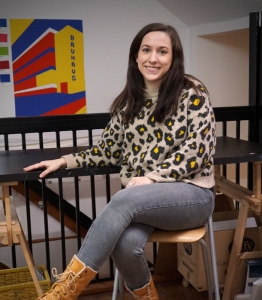
‘It’s been so nice to see the local press and radio have been hugely supportive of the Felixstowe Book Festival once again, which makes writing the articles about the forthcoming events and our Patrons all so worthwhile.

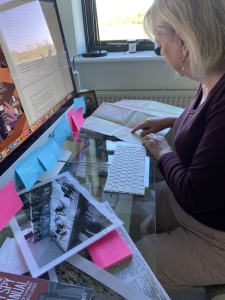
‘We’ve recently had a meeting (pictured) which involved the wider group of volunteers who all help to make the festival run like clockwork. As a thank you, we enjoyed some donated wine and chocolates to make the evening go with a swing!

‘However serious business was also discussed including an update on where we are at with current publicity. Although the festival is now only weeks away, there are still plenty of authors to write about, and interviews with visiting authors to conduct, and post online.Then, as the articles appear and the interviews are played, it’s about catching all of those and recording them for the committee to view once the festival is over. That way we can continually review our marketing strategies to see if we are reaching as many book-lovers as possible each year.

‘At the festival itself I’ll be armed with a camera to capture shots of the entertainment as it unfolds each day to share and to keep for next year’s publicity. So not quite time to get out the laurels and rest upon them, but I can see the light at the end of the tunnel – if I stand on a pile of books and scan the horizon that is!’

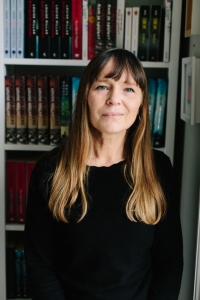
Louise Millar, blog editor

‘One of my favourite blog-slots this year has been our Where I Write series, which gives a fascinating insight into how authors work. I loved best-selling author Tracy Chevalier’s admission that she ignores her lovely writing room, and works on a corner of the sofa instead! We have four more of those blogs coming up, expertly captured on video by our publicist Steph during her interviews with writers for articles. I’ll be writing those up into copy and adding photos.

‘This week, I’ve also been commissioning blog posts from two non-fiction guests via theirpublicists. I feel that one advantage of the festival blog is how it allows us to dip into a wide range of upcoming events in advance, as we decide which events to book. Lucky for us all, our chair Meg has an excellent knack of spotting newsworthy trends months in advance, and these two books could not be more topical right now, with both authors recently appearing in the national news as expert commentators.

‘Watch this space to see who they are!’

Kerry Addison, sponsor co-ordinator

‘Recently, I have been working with our festival sponsors, checking their logo and company information is correct for our website and programme, and keeping them informed about our fantastic line-up.
‘We recently joined LinkedIn which is a good way of keeping in touch with our sponsors and supporters.  We can let others in the business community know who our loyal supporters and sponsors are, and in time we hope it will be a way of attracting more sponsorship to build on our work at the festival. We have a small but growing band of followers. If you use Linkedin, please do search for us!
‘I have also been posting updates about this year’s authors and events, hopefully reaching a wider audience.’

The committee making final plans for this year’s festival

Filed Under: Uncategorized

  • 1
  • 2
  • 3
  • …
  • 30
  • Next Page »

Blog

  • The book that changed me 28 February 2026

Subscribe to Our Newsletter

Check your inbox or spam folder to confirm your subscription.

Join the conversation…

  • Facebook
  • Instagram
  • Twitter
  • YouTube
Registered in England number: 10503186
Registered office: Suite 9, Orwell House, Ferry Lane, Felixstowe, IP11 3QL.
  • Home
  • Contact
  • Blog
  • About
  • Support us
  • Gallery
  • Events
  • Sponsors

Copyright © 2026 · Graphics by Rebecca Pymar · Site Policies · Log in