Blog editor Louise Millar asks Suffolk author Mary-Jane Riley about the difference between writing contemporary and historic thrillers, and to show us around her writing desk
Mary-Jane, your first four novels are contemporary thrillers set in East Anglia. What led you to write a new mystery series set in the 1940s, starring undercover intelligence offer Beattie Cavendish?
‘Serendipity! I was talking to my agent about what to write next and said what really interested me were the 1940s and 50s, the Cold War and spies. So, over a bottle or two of Prosecco we came up with my female spy, Beattie Cavendish – her surname a nod to a village in the county of Suffolk where I live. She’s working for a covert section of GCHQ (the Government Communications Headquarters).
‘As I thought about Beattie, I spoke to my brother about my parents, and discovered my mother had been in the intelligence service in WW11 and served on the private staff of Winston Churchill. Might she have been a Beattie if she hadn’t married immediately after the war and brought up four children?
‘My father had Irish parents and was awarded an MC for his part in the Battle of Monte Cassino, so I invented Irishman Patrick T Corrigan as a grumpy foil to Beattie and as a sort of tribute to him.’
What are the broad differences in process, for you, as an author, between writing an historic novel and a contemporary one?
‘With an historical novel, I think you must immerse yourself completely in the world about which you’re writing. Try to think how a determined woman of the 1940s might act, particularly with the restraints on such women at the time. And the research of course! So many rabbit holes to disappear down…’
Are there any benefits to setting a thriller in an historic period, rather than a contemporary one?
‘The fascination of learning about another period in history, not having to worry about mobile phones and technology ruining the mystery, and reading about spy craft of the era. I have a lovely little book called The Cold War Spy Pocket Manual, complete with pictures such as of lock-picks and a camera hidden in a lighter.’
Does your process differ depending on whether you’re writing an historical or contemporary mystery? Does your desk look different, for example?
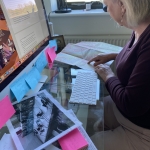
‘In many ways the planning and writing is similar. I begin with a notebook for ideas and I write the first chapter. I look out of the window. I procrastinate. There is a forest of Post-It notes stuck around my computer screen.
‘However, the main differences are that I have a picture nearby of my mother taken at the beginning of the war, and behind me on a pin board I might have an old map, a calendar of the year, pictures of vehicles or clothes.
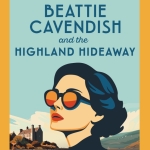
‘For “Beattie Cavendish and the Highland Hideaway”, I had photographs of 1940s coastal listening stations, the beach at Brora (though I called my place Kilbray) and Invelair Lodge, a real place where spies were believed to have been sent who were deemed “unfit” for active duty.
‘I also use an online etymology dictionary to avoid anachronistic language!’
With the 1940s series, do you start with plot and characters, then research the historical details later – or the other way around?
‘I usually start with some fascinating fact I have discovered along the way!
‘For instance, with “Beattie Cavendish and the White Pearl Club” I had read about the ingenious ways spies for Russia had hidden the secrets they’d stolen to send to their handlers. For the “Highland Hideway”, I’d read about Invelair Lodge, and also about the listening stations that intercepted both allied and enemy communications.’
As a writer, is it important that all historical details are accurate in a novel?
‘If I’m writing about a real Cold War event or operation – for example Operation Bloodstone whereby the CIA sought Nazis to work undercover – then I do want to be accurate. I find that having been a journalist I do like facts to be right but have to remind myself I’m a storyteller, not an historian!’
How does researching the Beattie novels compare to researching your contemporary ones? Does it make the process of writing a novel longer?
‘For research, I have my trusty book “GCHQ” by Richard J Aldrich which is the unofficial history of the organisation, and anything Ben Macintyre has written.
‘I read novels written by authors of the era, which helps with giving me the “ear” for the time, watch old films and I have watched a fair bit of “Foyle’s War”!
‘I like to travel to the place I’m writing about, too, if I’m able. There is more research involved writing a book set in the past, but I do tend to do the journalistic thing of only researching stuff I need as I write. And yes, it does take longer!’
Your Beattie series examines social injustices of the time. What motivates you to include those themes, and how do you avoid them slowing your thriller pace?
‘It was important for me that Beattie pushed against the conventions of the time and to be her own person – that women were strong and could be independent even if it was limited.
‘It did happen. There were women spies, although they were scarcely acknowledged and of course any working women had to stop when they married.
‘I find it incredible to think that women couldn’t get a mortgage independently without a male guarantor or open their own bank account until the passage of the Sex Discrimination Act in 1975. That’s in my lifetime.’
How do you make your historic series relatable for modern day readers?
‘Throughout the years men and women have fought and loved and cried and experienced birth and death and loss. We’ve been stupid and we’ve been clever. Human emotions haven’t changed, so I hope in that way my characters and thus my stories are relatable.’
Mary-Jane Riley will be discussing her Beattie Cavendish novels at the Felixstowe Book Festival on Sunday 28th June between 3pm and 4pm in conversation with Georgy Jamieson. Click here for tickets.