Felixstowe Book Festival

  • Home
  • Contact
  • Blog
  • About
    • About Felixstowe Book Festival
    • Your Visit
    • Festival Team
    • Felixstowe Book Festival Book Club
    • Archive
      • 2025 Festival
      • 2024 Festival
      • 2023 Festival
      • 2022 Festival
      • 2021 Festival
      • 2019 Festival
      • 2018 Festival
      • 2016 Festival
    • Ticket Information
    • Privacy policy
  • Support us
    • Become a Friend
    • Volunteer
  • Gallery
    • Gallery 2025
    • Gallery 2024
    • Gallery 2023
    • Gallery 2022
  • Events & Tickets
  • Sponsors
    • Our Sponsors and Funders
    • How to sponsor

Behind the scenes of the Felixstowe Book Festival
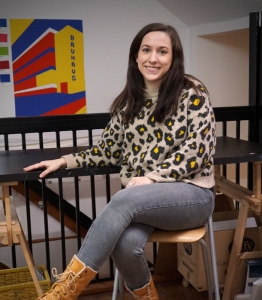
16 April 2026 By Steph Mack

Each spring, festival brochures and posters with stunning colour-block images appear in businesses around town, heralding the new programme of events. Louise Millar asks artist Rebecca Pymar about the process of creating her beautiful artwork

Rebecca, can you tell us, how you started designing for the Felixstowe Book Festival?

‘A lady connected to the festival saw my illustrations at Art on the Prom on Felixstowe Pier, about eight years ago, and forwarded them to the festival. Meg [Reid, festival chair] hadn’t quite found a style yet for their brochures and thought mine might work.’

What was the brief?

‘To marry books and the town. It was quite difficult at the start, putting “books” and “Felixstowe” together, without being cheesy. A bit of a head-scratcher!

‘I started off with an image of books next to a deckchair. That developed into an illustration of Felixstowe Docks, with books being loaded into a ship, rather than shipping containers. The books had flags on them, as a nod to the town’s international connections

‘We change the image every year, or every few years, depending on how well it works. This year we have the new beach huts, with the platform uprights replaced with books.’

Tell us a little about your art background.

‘I grew up in Suffolk, and did a fine art degree at Loughborough, training in painting and screen-printing, which is the method of pushing ink through a silk screen onto paper. Today, I mainly paint and illustrate digitally. My style is still informed by the principles of screen-printing, even though it isn’t something I get the opportunity to practise much anymore.’

Which artists have inspired you?

‘Artists who used print and colour, especially painters from the New York School, like Rothko and Barnett Newman. The way they used blocks of colour was quite revolutionary – the simplicity had an appeal for me.’

Your festival prints have a nostalgic yet contemporary feel – how do you achieve that?

‘People often say that they remind them of old travel posters. I think that’s because up till thirty or forty years ago, commercial posters were screen-printed.

‘At the time, it was the only way to deliver solid, flat blocks of colour to a large area.

‘The theory is that if an image is bigger, like on a poster or a painting, your eyes have to try to read it, to work out what they’re seeing. But when you have large, flat areas of colour, you can figure out what it says very quickly. The quicker you can see what an image is, the more impactful it is.

‘Vintage commercial art back then was designed to be glanced at. Posters were simple and clear, without too much fuss. That’s my style – I leave out the fuss!’

Do we see elements of art deco in your prints, too?

‘Yes. That’s due to the tourism boom in the 1920s and 1930s, where coastal towns like Felixstowe were marketed as a destination, with an influx of art deco additions. Felixstowe has lots of little art deco additions, like the spa pavilion.’

Yet your colours are quite contemporary? What is your inspiration for those?

‘When it’s a coastal image, my instinct is always to go with blues, yellow and oranges – for sand, sea and sky. They’re nice complimentary colours.’

Can you talk us through the design process for your festival illustrations?

‘Meg usually commissions me a few months before Christmas. We discuss ideas. This year we decided to include the new beach huts. They’re a new feature for Felixstowe, with the original site being reinstated as a heritage project.

‘To start with, I do a line drawing by hand, with paper and pen, working on scale, trying to get everything in proportion. Then I photograph the image and transfer it to my IPad and fill in the block colour digitally with Adobe Illustrator.

‘It feels bittersweet that a lot of work is done digitally now because of the technology available, but it does give you so many more options for editing and perfecting images. With practises like screen-printing, it is expensive and labour intensive and you must embrace the flaws! (Which I secretly do love about the process).

‘I then show a first draft to Meg. She sometimes makes a few edit suggestions, for example, adding the festoon lights to the beach huts illustration, or maybe asking for a corner of sea that points the image more towards Felixstowe.’

Your images are instantly recognisable as the book festival artwork. Do you regard part of your design role as being a branding specialist?

‘Primarily I see myself as an artist but as I have worked on several commercial and branding projects, I am able work with branding in mind, both in terms of colours and composition. For the Felixstowe artwork I try to keep the work consistent with the previous year so that it is recognisable. Once I have finished, I hand it over to a graphic designer who takes the branding element to the next level, designing the brochure, with layout, logos and fonts.’

Where can festival goers find your work?
‘I was pleasantly surprised when Meg suggested we sell the prints and cards at the festival. You can find them when you visit the event.’

What response have you had to your artwork over the years?

‘It’s really nice that people from Felixstowe recognise my work now, and comment on it on social media. I read all the comments. I live in Norwich now but have always felt a connection to the town through doing Art on the Prom. Doing this work for the festival makes me feel even more connected.’

Artist Rebecca Pymar
2026 Artwork

Filed Under: Book Blog, Felixstowe Book Festival 2026

The book that changed me

28 February 2026 By Steph Mack

Festival blog editor Louise Millar on Denis Johnson’s Train Dreams, the novella that fixed her writer’s block and returned her to the joy of reading

As the author of four published crime novels, to experience severe writer’s block, suddenly, in the middle of book five, felt like a nightmare.

How did it happen?

Unforeseen, traumatic family events can happen to any of us. In my case, they came all at once, leaving me both hypervigilant and foggy brained.

‘Secondary trauma’, was the diagnosis a doctor gave me, describing it like a mild PTSD.

I brushed the news aside, and returned to work. It would all be fine, I was sure. My urge to write remained strong, and if I kept going, the writer’s block would surely disappear.

But as I battled on through my fifth thriller, the plot became increasingly tangled. I felt as if I were tipping words from a dictionary onto the page and shuffling them around. They made sense, but I couldn’t feel them.

And if I couldn’t feel them, how could a reader?

Worse, I was struggling to read now, too. My eyes were skating off the page. Stephen King says, to be a writer one must ‘read a lot, and write a lot’ – and now I couldn’t do either.

So I put my tangled fifth novel away, and started a new one.

A year later, that wasn’t working either.

Later, a psychologist told me that when our brains experience trauma, they switch to survival mode, and take ‘offline’ the parts we don’t need. My imagination, it seemed, had gone ‘offline’, along with my ability to ‘feel’ words.

Abjectly, I found myself scrolling through Instagram, watching Netflix, and managing the odd audiobook – with lots of rewinds – eyeing the novels on my husband’s bedside table, envious of his ability to disappear into imaginary worlds I could no longer access.

As our family situation thankfully improved, and the fog lifted, I returned to writing short pieces about art and music, but it still felt like running through water. The only fiction I produced, whose words I could feel, was, not surprisingly, a short story about a woman fighting to regain her voice.

Then, in 2025, just before Christmas, I was telling a friend at work, who loves reading, how much I missed it.

‘Have you read Train Dreams, by Denis Johnson.’ He said, ‘It’s short – a novella.’

Truth was, Train Dreams, a story about a man working on the American railroads, sat on my bookshelf at home. I’d given up after Chapter One.

Later that day, as I was talking to another writer friend, I heard him pause mid-sentence.

‘Do you know you’re on that thing constantly?’ he asked.

I looked up and realised I’d been scrolling as he answered my question about how his own book was progressing.

‘And when you do talk,’ he continued, ‘it’s like your brain is scrolling through Instagram. It leaps about from idea to idea.’

I stood stunned. But I couldn’t argue. He was right. Something had to change.

That night, I went home and took Train Dreams off the shelf. It was 103 pages. Surely, I could manage a third of a novel.

My eyes skated off the first page, searching for my phone. I forced them back, and read on through the first chapter, then two more, battling to stay focused.

Before I knew it, I was immersed in beautiful elegiac writing about a character living in a forest scorched by fire, his memories buried in ash, watching new, green life return through the blackened ground, but now in different form.

The next morning, driving home from the gym, I felt an urge to do something. What was it? To check my phone? Then I realised it was to get back to my book.

I read on through Train Dreams that day. In it, I encountered an astonishing image of an injured forest creature that I know I’ll never forget. As I read on, I began to feel a rhythm to the novella that reminded me of train stops, each one a destination in the journey of a train labourer’s life through a rapidly changing America.

Finally, I made it to p103. We talk a lot about powerful opening lines in novels. I’m not sure I’ve read a more powerful last line, than in Denis Johnson’s Train Dreams.

I shut the book. I had done it. I could do it. I was a reader again. And now I wanted more.

Over Christmas I gathered and bought recommendations, including another novella by Hemingway and Barbara Kingsolver’s Demon Copperhead. In the New Year, I read Foreign Affairs by Alison Lurie, and raced through the short chapters of Clare Leslie Hall’s Broken Country. Right now, I’m in the middle of Patti Smith’s The Kids.

Then a strange thing happened two weeks ago. I woke up realising I had dreamt, for the first time in years.

My brain was sending me stories again.

I found myself thinking about Broken Country, and my own fifth novel. Would cutting the tangled plot into short chapters help?

A new character jumped into my mind, as I was driving to work. An ambitious young woman who works in Whitehall, who sees something she shouldn’t on the way to an interview.

I found the last draft of my fifth novel on my laptop, and cut in half the first chapter, about a woman who lives alone in rural Scotland. It suddenly felt more punchy. I inserted a new Chapter Two, set in London, introducing my new character. My brain began to chug along, then speed up, as it went to work connecting the two women and their locations.

If writer’s and reader’s block was just a stop on my own life journey, then I’m hoping that Denis Johnson’s Train Dreams has sent me onwards again.

Louise Millar – Blog Editor
“I was struggling to read now.”
Denis Johnson’s Train Dreams


Filed Under: Book Blog, Felixstowe Book Festival 2026

Blog

  • Behind the scenes of the Felixstowe Book Festival 16 April 2026

Subscribe to Our Newsletter

Check your inbox or spam folder to confirm your subscription.

Join the conversation…

  • Facebook
  • Instagram
  • Twitter
  • YouTube
Registered in England number: 10503186
Registered office: Suite 9, Orwell House, Ferry Lane, Felixstowe, IP11 3QL.
  • Home
  • Contact
  • Blog
  • About
  • Support us
  • Gallery
  • Events & Tickets
  • Sponsors

Copyright © 2026 · Graphics by Rebecca Pymar · Site Policies · Log in